
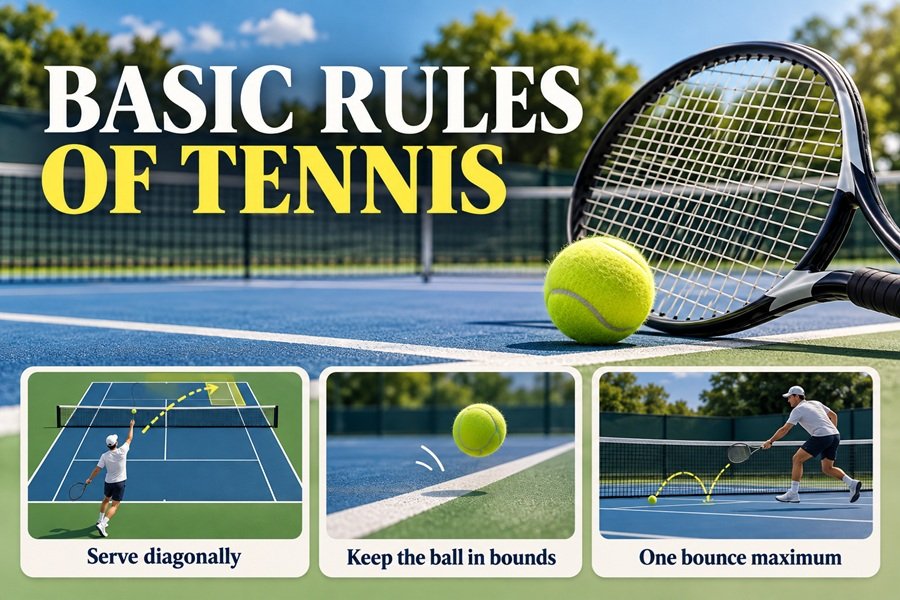
Understanding Tennis rules helps you enjoy your match. The scoring may seem strange. The court has many lines but every line has a clear job. When you know where to serve, how to count points and when a ball is out Tennis becomes fun without stopping after each rally.
Tennis mixes movement, placement and quick decisions. A powerful serve is not needed to start. Learning Tennis rules and keeping the ball in play are the first steps.
What Is the Aim of Tennis?
The aim of Tennis is to hit the ball into the opponent’s court so the opponent cannot return it legally. A point is earned when the opponent misses lands outside the boundaries or makes another point‑ending mistake.
Singles Tennis has one player on each side. Doubles Tennis has two players on each side. Points become games games become sets and sets decide the winner. Both the server and the receiver can win points.
Basic Rules of Tennis Court Boundaries
A Tennis court measures 78 feet in length. The width is 27 feet for Singles Tennis and 36 feet for Doubles Tennis. The extra strips on each side are called doubles alleys. Doubles alleys are part of the play area in Doubles Tennis. Are outside the play area in Singles Tennis.
The main Tennis court lines are:
| Tennis Court Line | Description |
|---|---|
| Baseline | The line at the back of each court. |
| Sidelines | The lines on the sides for Singles or Doubles Tennis. |
| Service line | The line that marks the back of the service boxes. |
| Centre service line | The line that splits the two service boxes. |
If a ball touches a line the ball is in. Even a tiny touch on the line counts.
How Tennis Scoring Works
In Tennis a regular game uses a scoring sequence instead of normal numbers. The sequence is:
| Points Won | Tennis Score |
|---|---|
| Zero | Love |
| One | 15 |
| Two | 30 |
| Three | 40 |
| Four | Game when a player has a two‑point lead. |
The server’s score is listed first. If the server has won two points and the receiver one point the score reads 30–15.
Advantage
When both Tennis players reach 40 the score is deuce. The next Tennis point gives the winner advantage. If that player wins the following point the player wins the Tennis game. If that player loses the point the score returns to deuce.
For example a Tennis player wins a point at deuce and gains advantage. The opponent then wins the point returning the score to deuce.
Some competitions use no‑ad scoring, where a single deciding point ends the Tennis game at deuce.
Winning a Set and Match
In a tiebreak Tennis set a player usually needs six games and a two‑game lead to win. A score of 6–4 finishes a set. At 5–5 winning the two games gives a 7–5 victory. If the score reaches 6–6 a tiebreak normally decides the set.
A best‑of‑three Tennis match requires two sets to win. A best‑of‑five Tennis match requires three sets.
Other Tennis formats exist, such as sets and a match tiebreak instead of a final set. Agree on the format before playing.
Tennis Serving Rules
Every Tennis point starts with a serve. Tennis players alternate service games and one player serves all points in each game.
Begin behind the baseline on the side of the centre line. The first Tennis serve of a game comes from the side and lands in the diagonally opposite service box. After each Tennis point switch serving sides.
Important Tennis serving rules are:
- Hit the ball before it touches the ground.
- Land the ball in the diagonal service box.
- Do not touch the baseline before striking the serve.
- Wait until the Tennis receiver is ready.
An underarm Tennis serve is legal when it follows these rules.
First Serve, Second Serve and Double Fault
A Tennis player receives two service attempts for each point. If the first attempt is a fault the player tries again. If the second attempt is also a fault the player commits a fault and the Tennis opponent wins the point.
A foot fault can happen when the player touches the baseline or steps into the Tennis court before striking the serve.
What Is a Let?
Under Tennis rules a serve that touches the net and then lands in the correct service box is a service let. The player repeats that serve.
A let, on a Tennis serve remains a second serve; the player does not receive a new first serve.
During a rally a ball that clips the net and lands legally remains in play. Some competitions also use a no-let service rule.
Rally. Losing Points
The receiver must let a legal serve bounce before returning the ball. After the return players may hit the ball before it bounces or after one bounce.
Hitting before the bounce is called a volley.
In tennis you lose the point when you:
- Allow two bounces before returning the ball.
- Hit the ball outside the relevant boundaries.
- Fail to make a legal return.
- Touch the net while the ball is in play.
- Let the ball touch your body or clothing.
An untouched legal serve is an ace. Wheelchair tennis has a two‑bounce rule.
How Tiebreaks Work
A standard set tiebreak counts points as 1, 2, 3 and so on. The first player to reach seven points with a lead wins.
At 6–6 continue until someone leads by two.
The first server serves one point. The opponent serves the next two and players then alternate two‑point service turns. Under rules change ends every six points.
Basic Doubles Rules
Doubles uses the court during rallies but the service boxes remain unchanged.
Partners establish a serving order. Receiving positions that stay fixed throughout the set. After the serve is returned either partner can hit the ball. Partners do not alternate shots.
Frequently Asked Questions
Can the receiver win a point?
Yes. Either side can win every point regardless of who serves.
Is a ball on the line in?
Yes provided it touches the boundary line.
Can you volley a serve?
No. A legal serve must bounce before the receiver returns the ball.
Conclusion
The basic rules of tennis become familiar, through practice. Start by serving calling the score clearly and watching the boundaries. Play a few games with someone experienced and focus on accurate returns before trying harder shots.
Leave a Reply